If you’re considering changing up your garden, finding a way to create a social space for you and your family and friends to gather is likely to be high on your list. And nothing completes a hang-out zone like a chiminea or fire pit. You can use a chiminea or fire pit as a focal point to generate heat and potentially even BBQ on, bringing everyone together in your cosy outdoor space. But, when it comes to chiminea vs fire pit, which one is better for your garden? Well, that entirely depends on you! Here’s our guide on chiminea vs fire pit to help you decide which is best for you.
What To Know About Fire Pits
A fire pit is a stylish addition to any garden, bringing plenty of warmth, convenience and versatility. Fire pits are open structures with a large bowl on a stand that can safely contain the fire. They can hold plenty of wood or similar fuel to keep a fire burning long into the night and allow for huge flames due to their open structure. Additionally, you can equip many fire pits with accessories such as grills to enable you to use your fire pit for cooking.
You can purchase fire pits made from various materials, from solid steel to cast iron. Alternatively, you could build your own fire pit from stone or concrete for a fixed structure in your garden.
Steel Fire Pits
Steel fire pits take the fire pit design one step further and can often be found in various fun designs and styles to suit any taste. Steel fire pits also offer a range of finishes, including plain, powder-coated and painted. A stainless steel fire pit is also the most portable style as they are nice and light, so you can move your fire pit wherever you wish. For a long-lasting, low-maintenance option, we’d recommend you choose stainless steel fire pits.
Cast Iron Fire Pits
Another common fire pit material is cast iron. Cast iron is heavier than steel, making these fire pits less portable, although they are best at maintaining higher temperature fires. They will also keep their warmth for a long time after the fire goes out. However, a cast iron fire pit will rust when left outside for too long, requiring more maintenance than a stainless steel option.
Stone/Concrete Fire Pits
Building your own may be the best option if you’d prefer a fixed fire pit. Usually, you can craft DIY fire pits from stone or concrete in a circular shape directly into your garden or patio. But, of course, you can also pay someone to build a stone or concrete fire pit for you. Although fire pits from stone or concrete require less maintenance and are incredibly sturdy, they are fixed in position, so if you go on a camping trip or move house, your fire pit must stay put.
Pros and Cons of Fire Pits
Pros
Cons
Affordable
Smoke can be overwhelming
Temperature control
Open structure can pose safety hazards if not contained properly
Suits different types of fuels, including regular wood
Requires the proper kindling
Radiates heat on all sides
Needs regular maintenance
Produce immense amounts of heat
Rustic appeal
What To Know About Chimineas
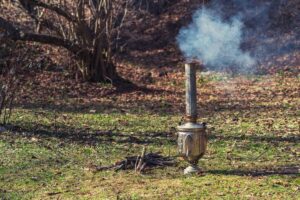
Chiminea derives from the Spanish word for chimney, which is essentially what a chiminea is! A chiminea has an opening in the front of its round base where you can stack fuel. The chimney attached to the top allows the smoke to travel upwards. Although chimineas have advanced into different sizes and shapes over the years, they remain primarily bulky structures with the same basic design.
What Types of Chimineas Are Available?
Like fire pits, you can get chimineas in a range of different materials. Although steel and cast iron are common materials, you can also purchase chimineas made from clay or terracotta for a Mexican twist.
Clay/Terracotta Chimineas
The traditional chimineas were made from clay and terracotta when people first used them in Mexico. In this style, they are usually brightly decorated and available in a range of styles. Clay and terracotta chimineas are less robust than other options and can crack under high temperatures or rough handling. However, clay or terracotta doesn’t get as hot as metal, so they may be a safer option.
Cast Iron Chimineas
Cast iron chimineas are better at providing higher temperatures since they won’t crack like clay or terracotta. Because of this, they can heat a larger area and will stay warm long after the fire has gone out. Plus, cast iron chimineas are suitable for cooking, which was the original use of chimineas. However, cast iron chimineas are prone to rust and will stay hot, potentially posing a safety hazard.
Steel Chimineas
Steel chimineas are the lightest choice with the most modern design. Although steel chimineas are easier to clean and less likely to be damaged, they often lose points when it comes to heat. As a result, a steel chiminea will produce and retain less warmth than cast iron, clay, or terracotta options.
Pros and Cons of Chimineas
Pros
Cons
Contained fire
Only receive heat from the open side
Controlled smoke
Small
Produce immense amounts of heat
Expensive
Warm large areas
Can fall over
Ease of use
Hard to maintain
Chiminea vs Fire Pit: What’s The Difference?
So now we know what chimineas and fire pits are. So, it’s time to explore the differences between them! All of these aspects should influence your decision when it comes to choosing a chiminea or fire pit, so consider each carefully.
Appearance
One of the main differences between chimineas and fire pits is their appearance. Fire pits are open structures in a bowl shape. Their open design allows you to create and burn larger fires that provide warmth and a view from all angles.
However, chimineas have an enclosed bowl base with a chiminea on top that takes the smoke away. As the base is enclosed, chimineas only allow a smaller opening to see and feel the benefits of the fire.
Size
Depending on the size of the space you have, a chiminea or fire pit may be better suited. Chimineas tend to work well in smaller spaces due to their size and shape. Generally, fire pits are better suited for larger areas, as they require plenty of space and enough room for smoke. However, you can get fire pits in smaller sizes.
Ease of Use
Both fire pits and chimineas are relatively easy to use. However, the main differences are in the preparation. For example, before lighting a fire, you must place sand or gravel at the bottom of a chiminea. But there is no need with a fire pit as you only need to add kindling and logs before lighting it up.
Heat
When it comes to heat, fire pits are slightly ahead of chimineas. Due to their open structure, fire pits release heat evenly in a 360-degree area. So, everyone sitting around it can benefit from the warmth. Additionally, you can add as much fuel as you’d like, so long as you are using coal or wood. Then, if you need more warmth, you can construct a larger fire.
On the other hand, chimineas don’t offer as much heat as fire pits. They are only open on one side, meaning only those sitting by the opening will benefit from the heat. Additionally, a chiminea takes longer to produce heat as it has restricted air access.
Smoke
How much smoke an outdoor appliance releases is essential to know. An excess of smoke can cause disruptions with neighbours, and they are well within their rights to make a complaint about smoke on the grounds of it being a statutory nuisance. So, whether you choose a chiminea or fire pit, you have to be sure that it won’t release enough smoke to be a nuisance to your neighbours.
How much smoke a chiminea or fire pit releases depends on the fuel you use. Usually, for a chiminea, fossil fuels such as charcoal release the least smoke. However, these kinds of fuels can be damaging to the environment. So, seasoned wood would be the best fuel choice. Despite this, whichever fuel you use, a chiminea is a sheltered structure with a chimney that directs smoke up and away from your garden and neighbours. This should lessen the amount of smoke you or your neighbours’ experience.
On the other hand, how much smoke a fire pit releases depends entirely on the fuel. As a fire pit is an open structure, it has little control over the smoke and where it goes. So, you should choose a safe fuel source to lessen the smoke a fire pit releases. We recommend kiln-dried firewood, as it is easy to light, long-burning and doesn’t spit. However, seasoned wood that has been well stored is also the perfect fire pit fuel.
Fuel
Both chimineas and fire pits can take the same fuel. However, the difference comes in size. As fire pits are more open, you can use larger pieces of firewood and throw them directly onto the fire. However, with a chiminea, there is a restriction on the size of fuel you can use. So, if using wood, you will have to cut it down to size.
Safety
Naturally, there are downsides when it comes to safety no matter if you have a chiminea or fire pit – they do hold fires, after all! However, although chimineas are closed structures, a fire pit may actually be safer since you can see the flame from all around. This visibility means that a fire pit is easier to avoid. However, chimineas only have an opening on one side, so their rears can cause a hazard. Additionally, both chimineas and fire pits can be hot to the touch depending on their material, causing another potential safety concern for children and pets.
Durability
With the right maintenance and care, both a chiminea or fire pit will last. However, traditional clay or terracotta chimineas are more fragile and prone to damage, although a cast iron option is more robust. On the other hand, fire pits of any material are made to be more durable and have less maintenance in the long term.
Chiminea or Fire Pit: Which Is Best For You?
Well, now we’ve explored as many elements as possible of chimineas and fire pits, it’s over to you now! Chiminea or fire pit? Which do you prefer? Which is best for your home? Consider their safety and smoke as a priority, then explore the space you have and the amount of maintenance you’d like to regularly put in. Then, you’ll have the answer that’s right for you!
Chiminea or fire pit – which do you prefer? Let us know in the comments!
Sourceshttps://myurbanjungle.com/explore/blog/can-i-have-a-bbq-in-my-garden/