

The Best Garden Bench Styles for Every Garden: Cottage to Contemporary – Sloane and Sons

Share

A garden bench is one of those pieces of outdoor furniture that does more than just provide somewhere to sit. Position it well and it becomes a focal point, a destination, a reason to step outside. Choose the wrong style and it can look like an afterthought – technically functional but visually disconnected from everything around it.
At Sloane and Sons, we stock a wide range of wooden garden benches designed to suit different garden styles. This guide walks through the main bench types and which gardens they work best in, so you can make a confident choice.
Start With Your Garden’s Character
Before looking at any specific bench, it helps to have a clear sense of what your garden already is – or what you want it to become.
Gardens generally fall into a few broad styles: cottage and informal, formal and traditional, contemporary and minimal, urban and compact, or naturalistic and wild. Most real gardens sit somewhere between two of these rather than squarely in one, but understanding the dominant character gives you a useful starting point.
The worst outcome is a bench that fights its surroundings. A sleek, low-profile contemporary bench in a cottage garden with climbing roses and irregular planting tends to look out of place, and vice versa.
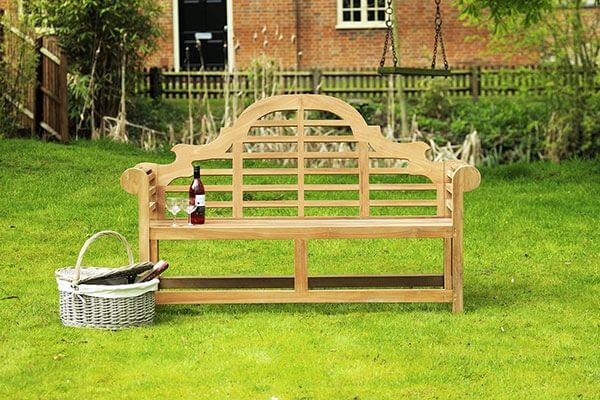
Cottage Garden Benches
Cottage gardens are characterised by dense, informal planting, a mix of colours and textures, and a general abundance that feels slightly unplanned – even when it is anything but. The right bench for this style leans into that character rather than trying to impose order on it.
Classic designs work particularly well here: arched backs, slatted seats, and traditional timber construction. The Lutyens bench is perhaps the most iconic choice for a cottage garden – its curved back and distinctive profile have been a feature of English gardens for over a century. Painted in a muted green, soft grey, or left to weather to silver teak, it settles naturally into a planted setting.
Positioning matters in a cottage garden. Rather than placing a bench prominently at the centre, consider tucking it into a corner, beside a climbing rose arch, or at the end of a path where it creates a sense of arrival.
Formal and Traditional Garden Benches
Formal gardens are defined by symmetry, structure, and geometry. Clipped hedges, straight paths, paired planting, and clear sightlines are the hallmarks. A bench in this setting needs to hold its own visually – it is often used as a deliberate focal point at the end of a vista or flanking a path in matching pairs.
Substantial, well-proportioned benches suit formal gardens best. Heavier designs with solid armrests and a strong silhouette read well against the clean lines of a formal layout. Three-seater benches work particularly well for this purpose – long enough to anchor a space, with enough presence to justify the sightline directed towards them.
Teak is an excellent choice here. Left to weather to silver-grey, it has a natural authority that suits formal spaces without appearing fussy.
Contemporary Garden Benches
Contemporary gardens tend to favour simplicity, clean lines, and restraint. Planting is usually more considered and less abundant, hard landscaping plays a bigger role, and the overall effect is calm and uncluttered.
Bench designs that work well in contemporary gardens have straightforward profiles – clean horizontal slats, minimal armrests or none at all, and a form that does not draw unnecessary attention to itself. The bench becomes part of the composition rather than a statement in its own right.
Material quality matters more in a contemporary setting where there is less softness from planting to distract the eye. Teak’s natural grain and warm tone (or its silver-grey weathered equivalent) hold up well under scrutiny in a way that painted softwood or plastic does not.
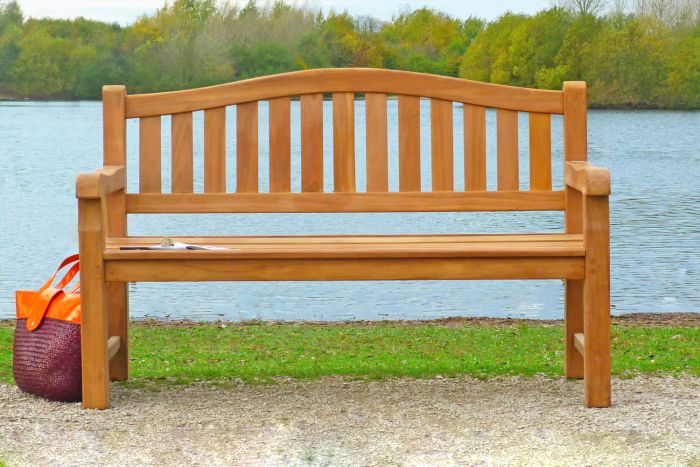
Park-Style Benches: Timeless and Versatile
Some bench styles work across almost every garden type because they have been refined over time to the point where they are simply right. Park benches fall into this category – their proportions and profiles are familiar without being generic, and they carry a quiet authority that suits a wide range of garden settings.
If you are unsure which style to choose, a well-made park-style teak bench is rarely the wrong answer.
Urban and Compact Garden Benches
Small urban gardens and courtyard spaces present a different set of challenges. A large, imposing bench can overwhelm a compact space, while something too small can look lost.
For smaller gardens, the key is proportion. A two-seater bench that fits the scale of the space is more effective than a three-seater squeezed in because you wanted the capacity. Consider also how the bench functions in a small space – can it double as storage, or sit flush against a wall to free up movement space when not in use?
Corner placement is particularly effective in compact gardens. A bench positioned diagonally across a corner makes use of otherwise dead space and creates a slightly more informal, sheltered feel.
Thinking About Wood and Finish
Regardless of style, solid teak is the most practical and long-lasting material for an outdoor bench that will spend year-round in the garden. It handles rain, temperature change, and UV exposure better than most alternatives, requires minimal maintenance, and improves visually with age.
If you are unsure how teak ages outdoors, our article on why teak turns grey explains the weathering process and what to expect.
Browse the Full Range
You can explore the complete collection of wooden garden benches at Sloane and Sons, including the Lutyens 3-seater teak bench, park benches, and three-seater benches across a range of styles.
If you are also furnishing your outdoor dining space, our outdoor teak dining furniture range offers designs that complement the bench collection for a coherent overall look.
